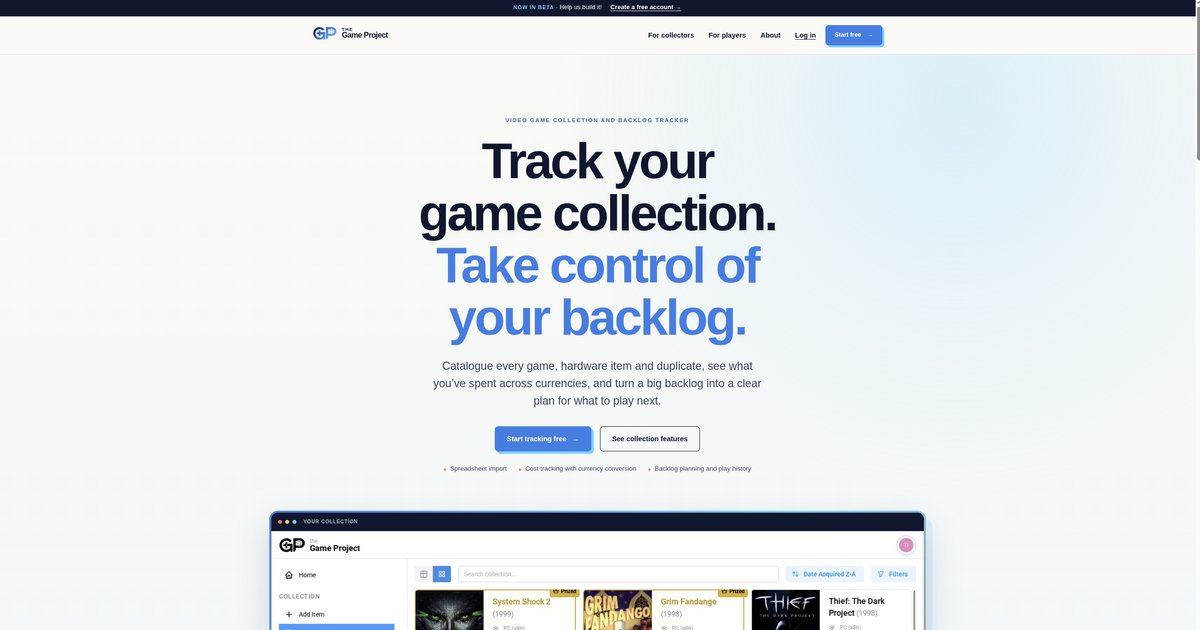
In March 2025, I decided to replace a spreadsheet.
I’d been using this particular spreadsheet for ten years to manage my video game collection. It contained all the wonderfully obscure details that matter to a video game collector and absolutely nobody else: editions, platforms, condition, box contents, purchase history, and the occasional uncomfortable reminder that I’d bought the same game three times. It had become a bit unweildy though - thousands of rows, difficult to search, and difficult to change.
Being an engineer, I naturally decided that the sensible thing to do was spend the next eighteen months building a product to replace it.
The result is The Game Project, which I soft-launched publicly in September 2026. But the most significant milestone for me wasn’t the public launch. It was the day I stopped updating the spreadsheet. After a decade of maintaining that data, entrusting it to a new system felt like a fairly consequential decision.
This was production now.
Over those eighteen months, the project became something of a laboratory for experimenting with technologies, engineering practices and product decisions. It also reinforced something I’ve come to believe quite strongly: if you’re in technical leadership, there’s enormous value in having something of your own to build.
Not because you need to demonstrate that you can still write code, or because you should be spending your evenings doing unpaid professional development. It’s because building something you genuinely care about teaches you things that are surprisingly difficult to learn any other way.
The Joy of Not Having a Steering Committee
One of the nice things about building software for yourself is that you can make a technical decision without first establishing a working group to investigate the feasibility of making a technical decision.
Want to try a different programming language? Go ahead. Interested in a new database? Give it a go. Think the architectural decision you made last month was a terrible mistake? Rip it out. Nobody’s going to ask you to present a business case for undoing it.
Now, before anyone interprets this as a rant about enterprise bureaucracy, there’s usually a perfectly good reason why these decisions are harder to make in a large organisation. There are security implications, regulatory requirements, existing platforms, commercial relationships, and, rather importantly, teams of people who are going to have to live with whatever you decide.
Introducing an unfamiliar technology into an organisation because you read an interesting blog post about it over the weekend is generally not a particularly responsible thing to do.
But the freedom to experiment without those considerations is enormously valuable. You can follow your curiosity, make mistakes, and develop an informed opinion about something before you’re in a position where that opinion has consequences for hundreds of other people.
Of course, personal projects have constraints of their own. At work, I might have access to a substantial cloud budget, specialist engineering teams and people whose job it is to make sure things keep running. At home, I have a credit card, a finite number of evenings, and an on-call rotation consisting entirely of me.
The interesting thing is how differently you approach engineering problems when you move between those two environments. Neither has a monopoly on good engineering. They’re just optimising for very different things, and spending time in both makes you a little more suspicious of anyone who claims there’s a universally correct way to build software.
Occasionally, Your Hobby Turns Out to Be Quite Useful
I didn’t build The Game Project as an elaborate professional development exercise. I like video games, I like building software, and I wanted a better way to manage my collection. Had someone suggested I spend eighteen months building a reference application to develop my technical leadership capabilities, I’d probably have found something more enjoyable to do.
Nevertheless, some of the things I learned building it turned out to be rather useful at work.
When I started the project, I had relatively little experience building backend services in TypeScript. I liked the idea of using the same language across the frontend and backend, so I built the API in Node.js and TypeScript and accepted that I’d spend a fair amount of time looking things up.
About six months later, an opportunity came up at work to build a proof of concept for a strategically important piece of middleware. By then, I’d developed enough practical experience with the technology to have a reasonably good idea of what was possible, how to approach it, and where the problems were likely to be.
That proof of concept subsequently became a production system and a highly successful project that enabled some important strategic partnerships. Without the experience I’d gained building a video game collection manager in my spare time, I’m not sure I’d have had the confidence or the practical knowledge to pursue that approach.
It’s a slightly absurd connection when you think about it, but that’s one of the things I like about learning through side projects. You don’t necessarily know which bits of knowledge are going to be useful, or when. You’re building up a collection of experiences that you can draw on when an interesting problem presents itself.
The same thing happened with agentic development. By the time we were looking seriously at rolling out these tools more broadly at work, I’d already spent a considerable amount of time using them to build and maintain a fairly substantial application. I’d seen them do impressive things, and I’d seen them do some spectacularly misguided things with equally impressive confidence.
That gave me a much better basis for contributing to the company’s direction and leading engineering enablement than I could have acquired from a vendor presentation.
Eighteen Months Is a Long Time in AI
The timing of the project turned out to be particularly interesting. The eighteen months I spent building The Game Project coincided with a fairly extraordinary period of change in the way we build software.
I started with Cursor, which at the time felt like a rather clever extension of the development experience I was already familiar with. It was essentially code completion with considerably more ambition, and it fitted quite naturally into the way I worked.
When the stronger Sonnet models arrived, I moved to Claude Code. The initial experience was somewhat mixed, and it took me a while to appreciate that the problem wasn’t necessarily the capabilities of the model. It was that I was still trying to work in much the same way I always had, only with a much more capable tool.
Over time, I developed an approach that separated problem discovery, solution discovery and implementation, which I’ve written about previously in Agentic Coding: Workflow Over Tools. As the models improved, this became my default way of working. I spent less time manually producing code and more time understanding problems, providing context, working through design decisions and verifying that the implementation actually did what I wanted.
More recently, I’ve moved much of my development work to Codex, partly because of the cost and latency I’d experienced elsewhere, and partly because I wanted to develop a firsthand understanding of a different tool and model family. I’ve been particularly impressed by the cost-to-performance of the Sol model, although there are aspects of the Claude Code harness that I still think are more mature.
I’m deliberately not making this a comparison of coding agents, because whatever I write will probably be out of date by the time you finish reading it.
What’s more interesting is that I’ve used several generations of these tools against the same evolving codebase. I’ve had to deal with the consequences of decisions made by earlier, less capable models. I’ve seen which engineering practices become more important as the tools improve, which become less important, and which apparently impressive capabilities don’t hold up particularly well when applied to a real application.
There’s a world of difference between getting an agent to build something impressive in twenty minutes and getting an agent to make a sensible change to a system you’ve been developing for eighteen months, without inadvertently undoing something important you worked out six months ago.
The latter is where a lot of the interesting engineering problems are.
Cloud Architecture Is Different When It’s Your Credit Card
One of the more educational aspects of building a personal project is discovering how much your architectural preferences change when you’re the person paying for them.
I knew how to build a reasonably conventional cloud architecture for The Game Project. An Aurora database, some resilient compute across ECS or EKS, ElastiCache, and all the associated networking and operational infrastructure. It’s a perfectly sensible architecture for many commercial applications, and one I’d be quite comfortable recommending under the right circumstances.
Unfortunately, the circumstances in this case involved me paying the bill.
There’s a fairly substantial cost floor associated with that kind of architecture, even before anybody is using your application. And at the cheaper end of the available configurations, you’re not necessarily getting a particularly impressive amount of compute or database performance for your money.
I like my video game collection, but I don’t like it a thousand dollars a month.
Instead, I bought some relatively inexpensive compute capacity and took on more of the operational responsibility myself. I use Dokku as a lightweight platform for running the API, background workers, PostgreSQL, Redis and various other components. It gives me much of the pleasant Heroku-style deployment experience without the corresponding bill.
I still use managed services where the economics make sense. AWS provides SES and SNS for email, S3 for object storage, and CloudFront for image delivery and transformation. Cloudflare takes care of static sites, CDN, DNS and email routing. My AWS resources are defined using CDK, so I still get repeatable infrastructure and environment isolation without feeling obliged to put absolutely everything in AWS.
Now, I can already hear someone explaining that I haven’t accounted for the cost of my own time, the operational risk, the maintenance burden, and all the other things that managed services are designed to alleviate.
They’re absolutely right. That’s precisely the trade-off I made.
In a large organisation, the cost of an engineer spending a few hours investigating a database issue can easily dwarf the additional cost of a managed database. In my case, the alternative might be spending a substantial amount of money every month on a hobby, and I actually quite enjoy understanding how the infrastructure works.
The exercise gave me a better appreciation of what managed services are really selling. You’re not just buying compute or storage; you’re paying someone else to be responsible for a collection of problems you’d otherwise have to deal with yourself. Whether that’s a good deal depends enormously on who you are, what you’re building, and how much you value not having those problems.
I find that a considerably more useful way to think about cloud architecture than treating managed services as an unquestionable best practice, or self-hosting as some sort of engineering virtue.
The Best LLM Is a Surprisingly Uninteresting Question
The Game Project uses language models for several data-processing tasks, and building those features has made me somewhat less interested in the endless discussions about which model is currently the best.
Best at what, exactly?
One of the features I’m particularly pleased with is Smart Import, which helps people bring their existing collection data into the application. If you’ve spent ten years maintaining a spreadsheet with your own peculiar conventions for recording video games, you probably don’t want to spend an entire Saturday reformatting it to satisfy somebody else’s data model.
LLMs are rather good at helping with this sort of problem. But because Smart Import is part of the onboarding experience, inference speed matters quite a lot. Every additional delay is another opportunity for someone to decide that importing their collection is more trouble than it’s worth.
Groq carries a cost premium, but its inference speed can make that premium worthwhile in this context. I’m not just paying for tokens; I’m paying for a better onboarding experience.
Compare that with the processing of inbound game data, which happens asynchronously in the background. Nobody is sitting there watching a spinner, waiting for the model to finish. Saving a few seconds of inference time has practically no value to the user, so I’m much more interested in the cost and effectiveness of the model for that particular task.
I initially made extensive use of DeepInfra, which is a good provider, but occasional outages and capacity limitations eventually led me towards OpenRouter. It’s a little more expensive, but having broader model availability and the ability to route around provider issues is worth something when you’re operating an actual product.
The application now uses a mixture of GPT mini, GLM, Qwen and Llama models, selected by benchmarking them against the tasks I actually need them to perform. Quality, latency, cost, availability and output consistency all factor into those decisions, with different weightings depending on the feature.
None of this is particularly revolutionary, but it’s the sort of thing that becomes much more apparent when you’re building a product rather than a demonstration. A model that performs brilliantly on a published benchmark might be an entirely inappropriate choice for a feature that needs to respond quickly, cheaply and consistently.
It’s amazing how much more interesting inference economics become when you’re paying the invoices from your own pocket.
Understanding Things Enough To Make Them Simple
One of the inevitable consequences of progressing into technical leadership is that you spend less time implementing things. There are organisational problems to solve, strategies to develop, investment decisions to make, and teams of people who need your attention. That’s the job, and I enjoy it.
But there’s a particular risk associated with getting too far away from implementation: you start to forget how much complexity can hide inside a perfectly innocuous sentence.
“Let users import a spreadsheet.”
That sounds like a fairly straightforward feature, doesn’t it? Spreadsheets are hardly an emerging technology. We’ve had decades to work this stuff out.
Except, of course, that people don’t organise their data in the way you’d like them to. They have their own conventions, inconsistent values, incomplete records, and little bits of information whose meaning is perfectly obvious to the person who entered them and completely impenetrable to everyone else. And somehow your application needs to make sense of all this without making the user regret trying your product.
The interesting part of engineering, for me, has always been the process of discovering the complexity underneath an apparently simple problem, developing a sufficiently good understanding of it, and then finding a way to collapse that understanding back into something genuinely simple.
There’s an enormous amount of satisfaction in that last step. Anyone who’s spent several days wrestling with a complicated design before suddenly realising that the whole thing can be expressed much more elegantly will know what I mean.
It’s also a process that’s easy to lose touch with as a technical leader. You see the feature description at one end and the finished implementation at the other, but much of the actual engineering happens in between, and it’s not always readily visible.
I think this matters even more in an agentic engineering world. Producing plausible-looking implementations is becoming remarkably easy. Understanding whether those implementations properly address the underlying problem, whether they’ve introduced unnecessary complexity, and whether they’ll hold up over time remains rather more difficult.
A technical leader who has spent some time wrestling with those problems firsthand is going to be better equipped to form an opinion about how engineering practices need to evolve than one whose understanding of the technology comes primarily from presentations and demonstrations.
That doesn’t mean every engineering leader needs to be writing production code every week. People bring different strengths to leadership, and there are plenty of ways to maintain technical fluency. But there’s no doubt, building things is a particularly effective way of keeping intuition calibrated against reality.
The Unreasonable Educational Value of Finishing Something
Like most software engineers, I have a collection of partially completed projects. They’re a sort of archaeological record of things I found interesting at various points in my life, and occasionally of technologies I was briefly convinced were going to change everything.
I don’t think there’s anything particularly wrong with that. Sometimes you want to explore an idea, learn something about a technology, or see whether an approach is feasible. Sometimes you explore a problem space and discover there isn’t an obvious way to collapse the complexity into a simple, elegant solution. The right solution is to not continue.
But there’s a whole category of engineering problems that you only encounter when you finish something and start depending on it.
A prototype doesn’t generally need a particularly sophisticated approach to data migration. If you make a mess of the database schema, you can probably drop the database and start again. You don’t need to worry quite so much about backwards compatibility, reliability, or what happens when a deployment goes wrong.
These are all much more interesting problems when the database contains ten years of information about your video game collection.
The day I stopped maintaining my spreadsheet was the day The Game Project became something I had to operate rather than something I was merely building. That distinction has taught me a great deal, and it’s why I’d encourage anyone who enjoys building side projects to occasionally see one through to the point where somebody, even if it’s just you, genuinely depends on it.
Mostly, I Just Like Building Things
I’ve spent much of this article making a case for side projects as a way of developing and maintaining the skills that matter in technical leadership. But there’s a danger in making the whole thing sound rather more purposeful than it actually was.
I didn’t spend eighteen months building The Game Project because I thought it would make me a better engineering leader. I spent eighteen months building it because I found it interesting, I enjoyed solving the problems, and I got an enormous amount of satisfaction from seeing the thing gradually come together.
The professional benefits were an unintended bonus.
I think it’s worth preserving that distinction. There’s enough pressure in our industry to be constantly developing ourselves, keeping up with new technologies, and making sure our skills remain relevant. Turning every hobby into another professional obligation seems like a fairly reliable way to take the enjoyment out of it.
What I value about side projects is that they give me an opportunity to follow my curiosity without having to justify where it’s taking me. Sometimes that leads to a useful technology experiment, sometimes it challenges an architectural assumption I’ve held for years, and sometimes it leads to me spending an evening solving an obscure problem that has no conceivable relevance to my professional life.
All of those are perfectly good ways to spend an evening, as far as I’m concerned.
Building things is what drew me into this profession in the first place, and after years of moving progressively further into technical and organisational leadership, it’s nice to be reminded that I still find it just as enjoyable.
And if doing something I enjoy also makes me a more informed, relevant and pragmatic technology leader, that seems like a pretty good arrangement.
The Game Project has been live since September 2026. If you collect video games, have a backlog that’s getting slightly out of hand, or are curious to see what happens when a software engineer decides he’s had enough of maintaining a spreadsheet, I’d love for you to take a look.