
This one’s a bit longer than usual. It’s been brewing for a year or more, so you might want to put the kettle on.
I’ve been watching the growing enthusiasm for Spec-Driven Development (SDD) with a mixture of curiosity, scepticism, and the sort of creeping dread you get when someone at work starts a sentence with “What if we fundamentally reimagined software engineering?”
This is usually followed by a diagram.
The diagram will have some boxes. There will be arrows between the boxes. One of the boxes will say “Specification”, and another will say “Implementation”, and the arrow between them will be doing an absolutely heroic amount of intellectual heavy lifting.
Now, I should establish something upfront: I think AI coding agents are genuinely transformative. I use them. I want them to succeed. I’m interested in figuring out how we reorganise software engineering to take advantage of them.
I’m not one of those people who thinks generating code with AI is cheating, or that real programmers must personally type every semicolon while listening to Pink Floyd on expensive headphones.
I’m all for writing the important requirements and constraints down before coding, and for the planning, testing and architectural discipline that SDD encourages. What bothers me about the more ambitious versions of SDD is the idea that specifications should replace code as the primary engineering artifact, with implementation becoming something we generate from the specification.
I have a fairly fundamental objection to that idea. We already invented a way of expressing computational behaviour precisely.
We call it a programming language.
The part where we remember why programming languages exist
Let’s rewind a bit. Computer science has spent the better part of a century developing increasingly sophisticated ways to express computation. We went from machine code to assembly, procedural languages, structured programming, functional programming, object-oriented programming, declarative languages, type systems, domain-specific languages, and all sorts of other clever things.
There have been some spectacular wrong turns along the way. We invented enterprise Java, for example, which demonstrated that it was possible to make a simple operation require seventeen interfaces and an XML file.
But the general direction has been towards better abstractions for expressing computational behaviour.
Programming languages aren’t some regrettable compromise we adopted because computers couldn’t understand English. They are specialised languages designed to express computation with greater precision, consistency, composability and economy than ordinary human language.
Consider a fairly ordinary piece of code:
const eligible = users.filter(
  user => user.active && user.balance > 0
);
This is remarkably compact. Try expressing its precise semantics in English. You’ll need to explain what constitutes a user, what active means, how balance is represented, whether zero qualifies, what happens with missing properties, whether the original collection is modified, whether ordering is preserved, and probably another dozen things.
Of course, the code doesn’t explain all of those things either. Some are defined by the language, some by the types, and some by the surrounding program.
That’s the point.
A programming language comes with an entire semantic framework that we don’t have to explain every time we write an expression.
Natural language doesn’t. And adding an LLM between the English and the code doesn’t suddenly change that fact.
The suspiciously familiar idea of making code a side effect
GitHub’s Spec Kit originally described SDD in fairly ambitious terms. Its published philosophy argues that specifications should become the primary artifact, with code becoming their expression. It describes maintaining software by evolving specifications and regenerating implementations.
That’s a different relationship between specification and implementation, and it’s where I start to get nervous. We’ve been here before, with fourth-generation languages, CASE tools, model-driven development, executable UML, various generations of visual programming, and more low-code platforms than anyone reasonably needs.
Every few years, someone discovers that writing software is difficult and proposes that we should instead describe the software using something other than software.
Then someone writes a generator and discovers that it needs to account for all the complicated things the original programming language was designed to express. The description language gets more complicated. Then we invent conditionals, expressions, data types, reusable components and extension mechanisms.
And eventually we’ve invented another programming language, except this one has terrible tooling and generates Java in the background.
I’m exaggerating, obviously. Some of these approaches have been useful, and domain-specific languages can be effective. Their successes generally come from introducing more precise abstractions.
SQL is successful because it is a formally defined declarative language within a specific domain. It isn’t successful because it resembles an English sentence.
An LLM that can generate SQL from a natural language request is a useful tool. It does not make English a superior replacement for SQL.
The specification completeness problem
Let’s suppose we’re building a meal-planning application. Our specification says:
“Generate a weekly meal plan that balances household preferences, nutrition, variety, preparation time and budget.”
Sounds reasonable. An agent could certainly build something from that. But what, exactly?
How do we balance preferences between household members? How do we calculate nutritional balance? What constitutes sufficient variety? Does the budget include pantry inventory? What happens when constraints conflict? What happens when a recipe has incomplete nutritional data?
We can clarify those questions in the specification, discover more questions, and clarify those too. Eventually, we either stop specifying and let the implementation make decisions that aren’t represented in the specification, or keep going until we’ve produced an extraordinarily detailed description of the desired computational behaviour.
At which point we should probably ask ourselves why we aren’t just writing the computational behaviour.
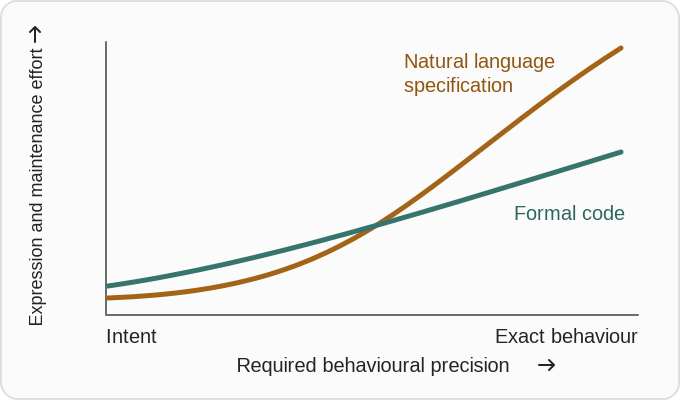
A conceptual comparison of effort at different levels of precision.
There’s a peculiar assumption in some SDD discussions that natural language is a higher level of abstraction than code. Sometimes it is. “Users should be able to recover their accounts” is a useful abstraction, but “higher level” doesn’t necessarily mean “better suited to being the authoritative definition of the system”.
A product requirement has a different job from a program. Trying to turn it into a program without admitting that you’re doing so just hides the complexity behind a translation step.
No, your AI agent isn’t a compiler
A compiler translates between representations according to defined language semantics. An AI coding agent interprets intent. Given an ambiguous requirement, an agent may choose a perfectly reasonable interpretation and produce a perfectly functioning implementation. Another agent may choose a different interpretation and produce a different, perfectly functioning implementation. Both may pass the tests they generated themselves.
Congratulations. We now have two confidently correct versions of the wrong thing.
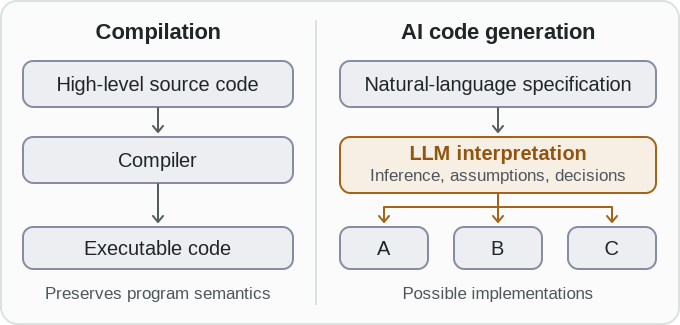
But let’s be generous and assume the agent gets it right the first time. The specification accurately captures our intent, and the implementation accurately reflects the specification.
Now we have to maintain the thing.
Six months later, we’ve fixed a dozen bugs, discovered some undocumented edge cases, optimised a particularly expensive database query, accommodated an external API that doesn’t quite behave as advertised, and made several small concessions to the inconvenient realities of production software.
Each of those changes potentially introduces knowledge into the implementation that wasn’t present in the original specification.
Now, the SDD answer is presumably that we should update the specification to reflect these discoveries. Which sounds suspiciously like the documentation maintenance problem we’ve been struggling with for decades, except that we’ve now promoted the documentation to the most important artifact in the system.
There’s a nasty dilemma here. Let the code evolve on its own and the spec goes stale. Start every behavioural change in the spec and every change comes with a translation job.
Without formal semantics for that translation, it’s hard to establish that the two say the same thing. We can ask an AI to check, but we’re asking for another interpretation. Keeping the two in sync is still our problem.
I’m struggling to see how this eliminates complexity rather than introducing more of it.
The SDD response is generally that we need better specifications, more explicit acceptance criteria, and stronger verification. Which is reasonable, but notice what’s happened. We’ve moved from the claim that specifications eliminate the gap between requirements and implementation to the considerably less revolutionary position that specifications provide useful guidance, but we still need to verify the implementation.
And yes. Of course we do.
The code is what actually runs. The specification is what we intended. The distinction between those things is not a historical defect that AI has finally corrected. It’s fundamental to engineering.
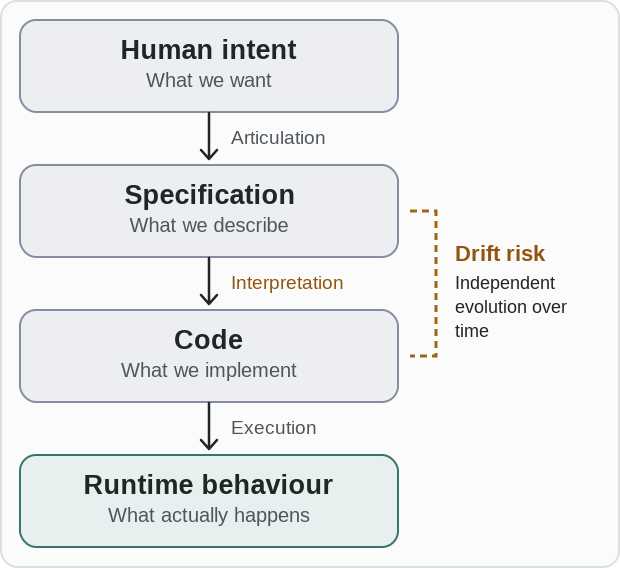
Generating one representation from another does not establish semantic equivalence or guarantee continued alignment.
Code is the truth, but not necessarily the whole truth
Here’s where I want to give SDD proponents their strongest argument. Code tells us what the system does. It doesn’t necessarily tell us what the system should do. That’s absolutely correct.
A function that allows any administrator to delete a customer account may be entirely unambiguous, beautifully typed, extensively tested, and catastrophically wrong from a business perspective.
Engineers have been putting intent next to code for decades. A comment at the permission check can say that support staff can help recover an account, but deletion requires the account owner’s consent. That’s a cheap place to record the rule, and the next person changing the check can see it right there in the diff.
Requirements capture broader intent. Tests check specific expectations, telemetry tells us what happens in production, and architecture decisions record the reasoning behind bigger choices.
If you want a detailed natural-language account of the whole system alongside the code, that document has to earn its keep. Otherwise we’ve just doubled the number of things that can be wrong.
The really interesting thing is what’s happening to SDD itself
In October 2025, Birgitta Böckeler published an excellent analysis of three SDD tools — Kiro, Spec Kit and Tessl — on Martin Fowler’s website.
She identified three distinct interpretations:
- Spec-first: Write a specification to guide a particular implementation.
- Spec-anchored: Maintain the specification alongside the implementation.
- Spec-as-source: Treat the specification as the principal source artifact, with code generated from it.
These are very different propositions. The first is essentially structured requirements-driven development with AI assistance, and the second introduces a persistent documentation responsibility. The third is the genuinely radical one, and it’s the one that interests me, because it’s making a substantive claim about the nature of software engineering.
But look at how these tools have evolved.
Spec Kit has become a more general process framework. It supports independent bug-fixing workflows, idea assessment, custom workflows, extensions, presets and different approaches to specification persistence. Kiro has introduced different paths for defects and design-first work, along with more flexible approval and verification mechanisms. General-purpose chat is now the default.
These are sensible developments, exactly the kinds of things I’d expect from tooling that is learning how engineers actually work. They’re also rather revealing. The original revolutionary vision seems to be converging on something considerably more familiar.
Different problems need different workflows. Agents need context and complex work benefits from planning. Engineering standards and testing matter, and humans need to review consequential decisions.
Stop me if you’ve heard any of this before.
Congratulations, we’ve reinvented competent engineering
Here’s where my frustration really starts.
Suppose I tell an AI agent to update a vulnerable dependency. I expect it to inspect the dependency, assess compatibility, make the change, run appropriate tests, identify breaking changes, and present a reviewable result. I don’t need a comprehensive feature specification.
Suppose I’m redesigning a complex customer-facing workflow. I want to explore alternatives, build a first pass, look at what actually works, change my mind, and iterate. I probably don’t want to spend hours creating an exhaustive specification for an interface I haven’t seen yet.
Suppose I’m changing the authentication architecture of a mature SaaS product. Now I absolutely want careful reasoning, explicit constraints, architectural discussion, compatibility requirements, rollback planning and substantial verification.
These are different engineering problems. A competent engineer understands that and doesn’t need every change to travel through the same sequence of documents to reach enlightenment.
There’s a fair counterargument here. AI agents aren’t consistently competent engineers. They misunderstand context, make assumptions and overengineer. They declare success prematurely or change things outside their scope. They’ll occasionally create a beautifully documented implementation of a bug you never asked for.
So yes, structured workflows can help, guardrails are valuable, and explicit engineering principles improve consistency. But none of these absolves the engineer directing the agent of the responsibility to exercise judgement during the writing of the actual code. Deciding what to delegate, how closely to supervise it, when to intervene and what constitutes sufficient verification are themselves engineering decisions.
And AI raises the stakes considerably. An engineer exercising poor judgement can now introduce unnecessary complexity and technical debt at a truly impressive rate.
The temptation to compensate for this with increasingly prescriptive processes is understandable. It’s also hardly new. But I’d rather have an engineer who understands why a particular change warrants careful specification than one who writes a specification because that’s what the process says to do.
The interesting challenge with AI isn’t how to eliminate the need for engineering judgement. It’s how to exercise it effectively when we can delegate so much more of the work.
The awkward possibility that AI makes code more important
There’s one final irony here. Historically, understanding a large codebase could be extremely expensive. You needed engineers who knew its history, architecture, dependencies, obscure edge cases and the reasoning behind decisions made years ago. Documentation helped compensate for that difficulty.
But AI is getting remarkably good at reading, searching, tracing and explaining code. It can navigate unfamiliar repositories, map dependencies, reconstruct execution paths and identify behavioural assumptions.
That’s an argument for prioritising code over documentation that can drift and become misleading. Give agents clear boundaries, good naming, strong types, explicit contracts, useful tests and sensible modularity. Write down the architectural decisions where they matter.
If an agent can understand the actual implementation, why should we force it to rely on a potentially incomplete and outdated description of that implementation?
The code has the advantage that it’s the executable truth. The specification may hold useful additional clarification at best, and contradictory misinformation at worst.
So what am I actually arguing?
By all means, give agents context, establish constraints, and be clear about what you’re trying to achieve. These were sensible practices before anyone put a three-letter acronym around them.
But even the idea that this necessarily involves writing a specification seems unnecessarily prescriptive. Some of my most productive interactions with coding agents are exploratory conversations. We investigate the existing system, consider alternatives, challenge assumptions, try things out and progressively arrive at an implementation. The conversation is part of the engineering process, not an elaborate preamble to it.
Sometimes it makes sense to consolidate that thinking into a specification, particularly when delegating a substantial piece of work. Sometimes it doesn’t. And once the work is done, I’m not particularly interested in maintaining a transcript of how we arrived at it.
There’s a world of difference between using specifications as a tool in the engineering process and committing to maintaining a parallel, natural language representation of system behaviour for the lifetime of the software. The latter is a significant ongoing obligation, and one that needs some convincing evidence to justify it.
I’d love to see better ways of engineering software with AI, grounded in computer science and backed by actual data. If maintaining long-lived specifications genuinely reduces maintenance costs, improves correctness and makes software easier to evolve, that’s worth getting excited about. Show me the results over several years of production changes, and explain how the problems of ambiguity, completeness and drift were overcome.
But those benefits need to be demonstrated, not inferred from the existence of a well-structured workflow. And I’m particularly sceptical of any approach that treats implementation as the mechanical part of software engineering. In my experience, that’s where an inconveniently large amount of engineering judgement is exercised and decisions are crystallised as running code.
I suppose I could finish this article by prescribing my own comprehensive development methodology.
But then I’d have to maintain a specification of how software engineering ought to work alongside the inconvenient reality of how it actually works.
And that’s more or less where we came in.